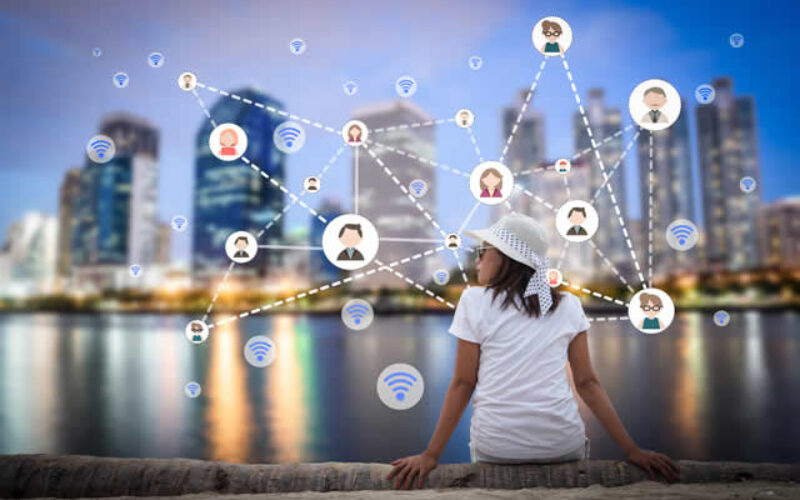
But the digital landscape we inhabit today is the result of a rapid, often turbulent evolution that has fundamentally shifted how humans interact.
Understanding this journey—from the early, clunky experiments of the dot-com era to the sophisticated, algorithm-driven giants of today—offers more than just a history lesson. It provides a map for navigating the digital world we live in now.
By looking at where we’ve been, we can better understand the forces shaping our online communities and, perhaps more importantly, prepare for what comes next. This exploration into the rise, fall, and rebirth of social platforms isn’t just about technology; it’s about the ever-changing story of human connection.
- post content
- The Early Days: Planting the Seeds of Connection
- The Rise of Giants: Building Walled Gardens
- The Mobile Revolution: Connection in Our Pockets
- The Content Boom: Everyone Is a Creator
- The Demise and Evolution: Adapt or Die
- The Future of Social Media: Immersion and Decentralization
- Nurturing a Healthy Digital Future
- view post (new win):TITLE
The Early Days: Planting the Seeds of Connection
Before the curated feeds and high-definition stories, there was a simpler desire to translate our real-world networks into a digital format. The early 2000s were a time of experimentation, where the concept of a "social network" was still finding its footing.
We saw the launch of Friendster in 2002, a platform that is widely credited as the grandfather of modern social media. It allowed users to create profiles, connect with friends, and surprisingly, view the connections of those friends. It was a novel concept that grew so rapidly the servers couldn’t keep up.
This technical fragility was Friendster’s undoing, but it proved there was a massive appetite for online connection. It paved the way for MySpace to emerge in 2003.
MySpace wasn’t just a directory of people; it was a canvas for self-expression. Users could customize their profiles with HTML, add music that played automatically, and rank their "Top 8" friends—a feature that caused no shortage of real-life drama.
For a brief, shining moment, MySpace was the most visited website in the United States, surpassing even Google. It showed us that social media could be a cultural force, influencing music, fashion, and how teenagers defined themselves.

The Rise of Giants: Building Walled Gardens
As the novelty of early platforms began to wane, a new wave of giants emerged, bringing structure and scalability that their predecessors lacked.
Facebook, launching initially for college students in 2004, prioritized a clean, uniform aesthetic over the chaotic customization of MySpace. It verified identity through university email addresses, creating an initial sense of exclusivity and trust.
By the time it opened to the general public, it had established a robust infrastructure capable of handling millions of users without crashing—a lesson learned from Friendster’s struggles.
Parallel to Facebook’s methodical expansion was the birth of Twitter (now X) in 2006. Twitter introduced a radical constraint: 140 characters. This limitation forced brevity and immediacy, turning the platform into a global town square for real-time news and conversation.
It wasn’t about connecting with people you knew from high school; it was about connecting with ideas and events as they happened.
Meanwhile, LinkedIn carved out a niche for professional networking. Launched in 2003, it grew quietly but steadily by focusing on utility rather than entertainment.
It became the digital resume and the rolodex for the modern worker, proving that social networking had valid applications beyond socializing. These three platforms—Facebook, Twitter, and LinkedIn—solidified the social media model, moving it from a niche hobby to a central pillar of the internet.
The Mobile Revolution: Connection in Our Pockets
The introduction of the smartphone changed everything. Before the iPhone arrived in 2007, social media was largely a desktop activity. You went home, sat at a computer, and "logged on."
The smartphone dissolved this boundary. Suddenly, social media was something that lived in our pockets, accessible at the bus stop, during dinner, or in bed.
This shift to mobile-first usage demanded a change in how platforms functioned. It wasn’t enough to just have a mobile-friendly website; apps became the primary gateway. Facebook struggled initially to pivot but eventually dominated the mobile space.
However, new entrants like Instagram, launching in 2010, were native to this environment. Instagram was built specifically for the smartphone camera. It stripped away the status updates and links, focusing entirely on visual sharing. It made photography accessible and social, turning everyday moments into curated galleries.
This era also saw the rise of ephemeral messaging with Snapchat. It challenged the idea that everything posted online had to be permanent.
By allowing photos and videos to disappear after viewing, it brought a sense of spontaneity and privacy back to digital communication, appealing heavily to younger users who were wary of the permanent digital footprint left on Facebook.
an interesting viewpoint from our remodeling center

AI Home Health Devices: Your Guide to Smart Wellness Technology
Whether you’re managing a chronic condition, optimizing your fitness routine, or simply taking a more proactive approach to health, AI home health devices offer unprecedented insights into your body’s patterns and needs.
The Content Boom: Everyone Is a Creator
As mobile access became ubiquitous, the barrier to creating content vanished. We moved from an era of text-based status updates to rich, multimedia storytelling. YouTube had long established video as a pillar of the internet, but the tools for high-quality video creation were now in everyone’s hands.
This democratization of content creation birthed the "influencer" economy. Ordinary people could amass followings that rivaled traditional celebrities, monetizing their lifestyles and expertise.
The landscape shifted again with the rise of TikTok. While Instagram and YouTube were about following specific people, TikTok’s algorithm prioritized the content itself. You didn’t need followers to go viral; you just needed to make a video that engaged the algorithm.
This model of "interest graphs" over "social graphs" changed how we discover content. It made entertainment the primary goal, blurring the lines between social networking and media consumption. Users were no longer just sharing their lives with friends; they were performing for a global audience.
This boom forced legacy platforms to adapt. Instagram introduced Reels, and YouTube launched Shorts, all chasing the short-form video trend. The focus shifted from connection to retention—keeping users glued to the screen for as long as possible.
The Demise and Evolution: Adapt or Die
The history of social media is littered with the ghosts of platforms that failed to adapt. Vine, a pioneer in short-form video, couldn’t find a sustainable business model and was shut down by Twitter, despite its massive cultural impact.
Google+ attempted to force a social layer across all Google products but failed to offer a compelling reason for users to switch from Facebook. These failures highlight a crucial truth: a large user base or deep pockets do not guarantee survival.
Successful platforms are those that evolve. Facebook, seeing the stagnation of its core app among younger demographics, acquired Instagram and WhatsApp, diversifying its portfolio. It pivoted to become "Meta," signaling a shift toward the metaverse.
Twitter, under new ownership, has attempted drastic changes to its verification and content moderation policies, alienating some users while attracting others, illustrating the volatility of these digital town squares.
We are also seeing a fragmentation of the social landscape. Users are increasingly moving away from "town square" platforms where everyone shouts at everyone, toward smaller, private communities.
Platforms like Discord and Telegram have surged in popularity, offering spaces organized around specific interests rather than general connections. This shift suggests a growing fatigue with the algorithmic feed and a desire for more authentic, manageable interactions.
The Future of Social Media: Immersion and Decentralization
As we look toward the horizon, the next evolution of social media appears to be diverging into two distinct paths: deep immersion and decentralized ownership.
The concept of the Metaverse, while still in its infancy, promises a shift from looking at screens to inhabiting digital spaces. Virtual Reality (VR) and Augmented Reality (AR) aim to make digital social interaction feel as present as physical interaction.
Imagine attending a concert with a friend who lives across the ocean, not by watching a livestream, but by standing next to their avatar in a virtual crowd. While adoption is currently slowed by hardware costs and usability issues, the long-term trend points toward spatial computing.
Simultaneously, there is a growing movement toward decentralized social networks, often referred to as the "Fediverse." Platforms like Mastodon and Bluesky operate on open protocols rather than closed, corporate-owned servers.
This architecture gives users ownership of their data and their social graph. If you leave one server, you can take your followers and content with you.
This reaction against the "walled gardens" of Big Tech reflects a desire for a more democratic internet, where algorithms are transparent and users have control over what they see.
Artificial Intelligence will act as the accelerant for both these futures. AI is already curating our feeds, but soon it will likely help generate content, moderate communities in real-time, and perhaps even act as a social companion.
We may see the rise of "synthetic media," where AI-generated influencers and personalities interact with human users, further blurring the line between reality and digital fabrication.
other related articles of interest:
Stay Safe Online Tips for Managing Social Media Use and Spotting Imposters
Parenting and Emotional Intelligence: A Guide to Raising Resilient and Empathetic Children
Nurturing a Healthy Digital Future
The story of social media is a reflection of our own desire to be seen, heard, and connected. We have moved from the excitement of finding old friends on Friendster to navigating complex, algorithmically driven ecosystems that influence global culture and politics. The technology has changed, but the fundamental human need remains the same.
As we step into this new era of AI and immersive experiences, the challenge will be to ensure these tools serve us, rather than the other way around. We must cultivate digital environments that support our well-being, prioritizing genuine connection over engagement metrics.
The future of social media isn’t just about what the technology can do; it’s about what we choose to do with it. By understanding where we’ve come from, we can make more intentional choices about where we go next, ensuring our digital gardens continue to bloom with healthy, meaningful interactions.
Image Credit: future of social media by envato.com
end of post … please share it!
end of post idea for home improvement
view and analyze home improvement ideas at our LetsRenovate center
Helpful article? Leave us a quick comment below.
And please give this article a rating and/or share it within your social networks.