


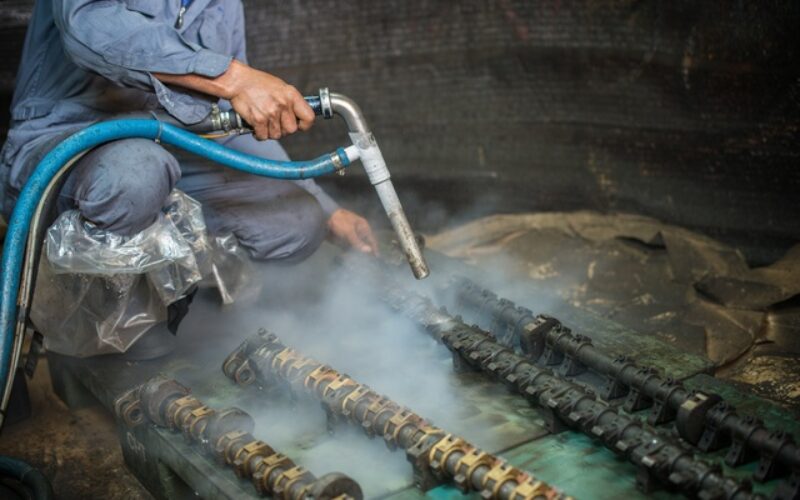
Traditional methods often involve harsh chemicals and manual labor, but technology has advanced.
Today, there are many effective modern surface cleaning solutions for manufacturers that offer improved performance and a better safety profile. Let’s walk through current technologies.
Common Soils and Substrate Sensitivities
The first step in selecting a cleaning method is to identify what you need to remove and from what surface. Common industrial soils include oils, greases, rust, paint, oxides, and other contaminants. Each type of soil requires a different approach.
Equally important is the substrate, or the base material of the part. Some materials, like soft aluminum or sensitive composites, can be easily damaged by aggressive cleaning methods. You must match the cleaning process to both the soil type and the substrate’s sensitivity to avoid damaging your parts.
An Overview of Leading Technologies
Several advanced cleaning methods are available today, each with specific strengths.
Aqueous & Solvent Alternatives
Water-based (aqueous) cleaning systems use detergents and mechanical action to lift away contaminants. Modern solvent alternatives are also available that have a lower environmental and health impact than older, chlorinated solvents. These are effective for general degreasing on a wide variety of parts.
Dry Ice Blasting
This method propels solid CO2 pellets at a surface. The pellets sublimate on impact. This means it creates a micro-explosion that lifts contaminants without creating secondary waste or abrading the surface. It is excellent for cleaning molds, tooling, and production equipment.
Ultrasonic Cleaning
Parts are submerged in a tank where high-frequency sound waves create tiny, imploding bubbles. This process, called cavitation, gently scrubs surfaces, even in hard-to-reach crevices. It works very well for complex parts with intricate geometries.
Laser Cleaning
This technology uses a focused laser beam to ablate or vaporize contaminants from a surface. The way laser cleaning equipment works is with precision, non-contact methods. It’s a dry process that directs short pulses of high-energy light that are absorbed by the contaminant layer, causing it to vaporize or peel away, leaving the substrate untouched. It’s ideal for targeted rust removal, paint stripping, and mold cleaning.
Process Validation and Safety Considerations
Implementing a new cleaning system requires careful planning. Process validation is necessary to confirm the method consistently achieves the required level of cleanliness without harming the parts.
You should also evaluate the environmental, health, and safety (EHS) impact. Consider factors like chemical handling and disposal, ventilation needs, noise levels, and operator training requirements. New technologies often provide significant EHS benefits over older methods.
Selecting the Right Solution
Your final choice depends on several operational factors. Throughput is a major consideration; some systems are better suited for high-volume batch processing, while others excel at in-line, single-piece flow.
The geometry of your parts also plays a huge role. Complex parts with internal channels might require ultrasonic or aqueous systems, whereas large, flat surfaces could be cleaned efficiently with other methods.
By evaluating your specific variables, you can select the best modern surface cleaning solutions for manufacturers to optimize your processes.
Image Credentials: by Nabby, File #104289589
end of post … please share it!
end of post idea for home improvement
view and analyze home improvement ideas at our LetsRenovate center
Helpful article? Leave us a quick comment below.
And please give this article a rating and/or share it within your social networks.


