Quick Answer:
Time isn’t a universal constant ticking at the same rate for everyone. Einstein proved that time is relative—it bends and stretches depending on how fast you’re moving and how strong the gravity around you is. Space and time are woven together into a single fabric called spacetime, and while physics still debates why time moves forward, one direction, entropy, gives us the clearest answer yet.
It turns out time itself behaves strangely once you look closely enough, and Einstein was the first to prove it mathematically. Time is a dimension, intertwined with space, motion, and gravity.
It isn’t a fixed backdrop that treats every observer the same way. Instead, it flows differently depending on where you are and how fast you’re traveling through the universe.
That idea can feel unsettling at first. We’re taught to think of time as steady and universal, something that ticks along the same for everyone, everywhere. But the moment you start asking what time actually is, the answer gets far more interesting than a ticking clock.
It turns out time itself behaves strangely once you look closely enough, and Einstein was the first to prove it mathematically. Time is a dimension, intertwined with space, motion, and gravity.
It isn’t a fixed backdrop that treats every observer the same way. Instead, it flows differently depending on where you are and how fast you’re traveling through the universe.
That idea can feel unsettling at first. We’re taught to think of time as steady and universal, something that ticks along the same for everyone, everywhere. But the moment you start asking what time actually is, the answer gets far more interesting than a ticking clock.
What Time Means In Simple Terms
At its core, time is the dimension we use to order events, from past, to present, to future. Unlike space, where you can walk forward, backward, left, or right, time appears to move in a single direction.
We measure it using clocks, which track the intervals between recurring events, whether that’s the swing of a pendulum, the rotation of the Earth, or the vibration of a cesium atom.
This everyday, intuitive sense of time works perfectly well for daily life. It’s when you zoom out to the scale of galaxies, or in to the scale of atoms, that the simple picture starts to break down.

Newton’s Universal Clock
For centuries, physics treated time the way Isaac Newton described it: as an absolute, universal backdrop. In this view, time passes uniformly everywhere, completely independent of what’s happening in the universe.
Two accurate clocks, no matter where they sat, would always agree on how much time had passed.
This assumption served science remarkably well. It’s still accurate enough for construction projects, daily scheduling, and most engineering work. The trouble is, it isn’t the whole truth.
Einstein’s Relative Time
Albert Einstein’s theories of special and general relativity changed our understanding of time completely. Rather than a separate, universal quantity, Einstein showed that time is woven together with space into a single four-dimensional structure called spacetime.
Two consequences follow from this, and both have been measured, not just theorized. First, speed affects the passage of time: a clock moving very fast relative to another accumulates less elapsed time when the two are later compared.
Second, gravity affects time too: a clock sitting deeper within a gravitational field runs measurably slower than one positioned higher up.
Think of it like this: each of us carries a personal "watch" as we move through spacetime, and physicists call the time it shows our proper time.
Two people who take very different paths, especially involving high speeds or differing gravity, can reunite later with genuinely different amounts of time having passed on their watches.
Why Time Matters In The Real World
This isn’t just an abstract curiosity reserved for physicists. GPS satellites orbit at roughly 14,000 kilometers per hour, and they also sit farther from Earth’s gravitational pull than we do on the surface.
Both factors shift how quickly time passes for them relative to us. Without built-in corrections for these relativistic effects, GPS positioning would drift and become inaccurate within hours. Every time your phone pinpoints your location, it’s quietly relying on Einstein’s century-old equations.
The Arrow Of Time
Here’s a puzzle that relativity alone doesn’t solve: why does time only seem to move forward? Most of the fundamental equations in physics work just as well mathematically whether time runs forward or backward.
Yet in the real world, eggs scramble but never unscramble themselves, and we remember yesterday but never tomorrow.
The most convincing explanation comes from thermodynamics, specifically the concept of entropy, which measures the disorder within a system. In an isolated system, entropy tends to increase over time, and that steady climb toward disorder gives time its forward-moving direction.
Notably, this doesn’t mean everything gets messier all the time. A tidy room stays tidy only by exporting energy and increasing entropy elsewhere, like the effort you spend cleaning it.
What Physics Is Still Discovering
The story doesn’t end with Einstein and entropy. Researchers continue to probe why time behaves the way it does, and some of the newest thinking suggests time might not be as fundamental as it feels.
A 2026 study published via The Conversation and reported by Phys.org proposed that temporal order emerges from the irreversible way physical interactions imprint information into spacetime itself, rather than existing as a built-in feature of the universe (Neukart, 2026).
In this framework, spacetime behaves almost like a memory, recording every interaction that has ever occurred, and time’s forward direction reflects the simple fact that this record only ever grows.
Other physicists continue to wrestle with reconciling relativity’s view of time as a dimension with quantum mechanics’ treatment of time as a mere background parameter, a tension sometimes called the "problem of time" (Al-Khalili, 2025).
It’s a reminder that even after more than a century of progress, time remains one of physics’ most active frontiers.
Time Is Far Stranger Than It Feels
Time is far more layered than the steady ticking of a clock suggests. Modern physics confirms that it’s relative, shaped by motion and gravity, and inseparably bound to space itself. At the same time, questions about why it flows in only one direction, and what that means at the deepest level of reality, are still very much open.
Understanding these ideas doesn’t just satisfy curiosity. It deepens appreciation for the technology we rely on daily and the universe we quietly move through every single moment.
life-management ideas to consider (complete directory – new win):


Frequently Asked Questions
-
Does time actually exist, or is it something humans invented?
Time is both a real physical phenomenon and a human construct for measurement. Physics confirms that time exists as a dimension within spacetime, while the clocks and calendars we use are human tools built to organize and track it.
-
Can time travel ever be possible?
According to relativity, traveling forward in time is theoretically achievable through extreme speeds or strong gravity, and it’s already measured in small amounts with satellites and fast-moving particles. Traveling backward in time remains speculative and raises unresolved logical paradoxes.
-
Why does time seem to pass faster or slower depending on the situation?
Our perception of time is largely psychological, shaped by attention, emotion, and how memories form in the moment. The actual passage of time, as measured by a clock, stays consistent regardless of how we experience it.
-
What is spacetime?
Spacetime is the four-dimensional framework that combines the three dimensions of space with time into a single, unified structure. Einstein’s theories of relativity showed that space and time cannot be fully separated from one another.
-
How does gravity slow down time?
General relativity shows that clocks positioned deeper within a gravitational field run more slowly compared to clocks farther away from that field. This effect, called gravitational time dilation, has been confirmed through precise atomic clock experiments.
-
What is the arrow of time?
The arrow of time refers to the one-way direction in which time appears to flow, from past to future. Physicists most often explain this using entropy, the tendency for disorder to increase within an isolated system.
-
What do physicists mean when they say time might be an illusion?
Some theories in quantum gravity, including the well-known Wheeler-DeWitt equation, describe the universe in a way where time doesn’t appear as a variable at all.
This has led some physicists to argue that our sense of time flowing might emerge from deeper processes rather than being a fundamental feature of reality.
-
How do GPS satellites correct for Einstein’s relativity?
GPS satellites travel at high speeds and sit farther from Earth’s gravitational pull, both of which affect how quickly time passes for them relative to receivers on the ground.
Engineers build relativistic corrections directly into the GPS system, ensuring the location data you rely on stays accurate.
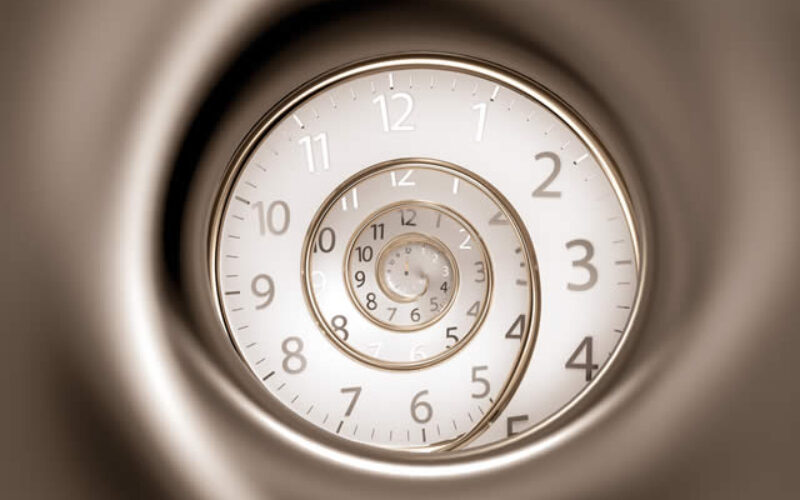
Image Credit: theory of time by envato.com
end of post … please share it!
end of post idea for home improvement
view and analyze home improvement ideas at our LetsRenovate center
Helpful article? Leave us a quick comment below.
And please give this article a rating and/or share it within your social networks.