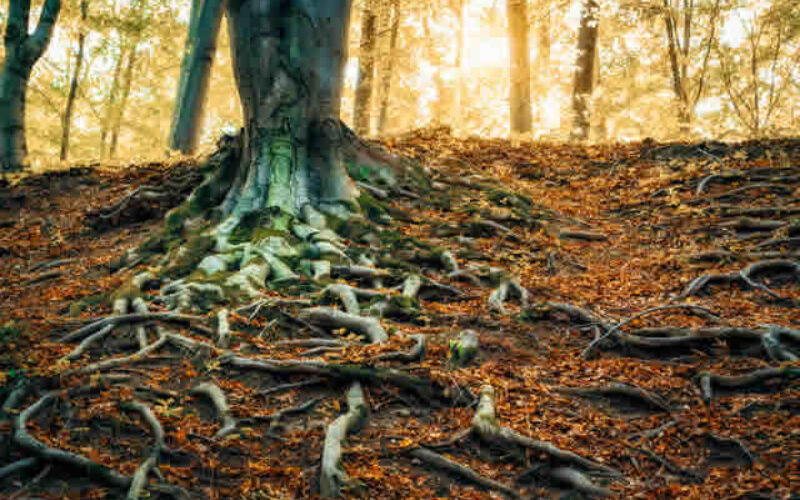
However, beneath the soft earth you walk upon, there is a bustling, vibrant world of communication and cooperation that challenges everything we thought we knew about plant life. It is a hidden universe where trees talk, share food, and even warn each other of danger.
This subterranean social network is built upon mycorrhizal networks, intimate partnerships between plant roots and fungi. These connections link individual trees and plants into a shared web, allowing them to exchange nutrients, water, and vital chemical signals.
These networks are so complex and efficient that scientists have dubbed them the "wood wide web." Understanding these underground alliances changes how we view forests—not as collections of individuals competing for resources, but as intelligent, collaborative communities that work together to thrive.
- post content
- What are Mycorrhizae and Mycelium?
- Types of Mycorrhizae: Arbuscular vs. Ectomycorrhizae
- The Common Mycorrhizal Network: The “Wood Wide Web”
- Nutrient Exchange and Resource Allocation
- Chemical Signaling and Communication
- The Role of “Mother Trees”
- The Web of Life: Connecting Diverse Plants
- Evidence of CMN Influence on Forest Ecosystems
- Challenges and Future Research Directions
- The Future of Understanding Forest Intelligence
- side idea:5 Tree Care Investments
- content summary table
What are Mycorrhizae and Mycelium?
To understand the forest’s internet, we must first look at the basic building blocks: the relationship between fungi and roots.
The term "mycorrhiza" literally translates to "fungus-root." It describes a symbiotic relationship where specific fungi colonize the root system of a host plant. This isn’t a parasitic invasion; rather, it is a mutually beneficial trade agreement that has existed for millions of years.
The fungus extends out into the soil using incredibly thin, thread-like structures called hyphae. Collectively, these threads form a vast, intricate mesh known as mycelium.
While plant roots are thick and somewhat limited in their reach, fungal hyphae are microscopic and can navigate the tiniest pores in the soil. This allows the fungus to access water and essential nutrients like phosphorus and nitrogen that the plant cannot reach on its own.
In exchange for these precious soil resources, the plant pays the fungus with sugar. Through photosynthesis, plants convert sunlight into carbohydrates—energy that the underground fungi cannot produce for themselves.
The plant sends this sugar down to its roots to feed its fungal partners. It is a perfect biological barter system where the fungi act as an extension of the plant’s root system, vastly increasing its ability to drink and eat from the soil.

Types of Mycorrhizae: Arbuscular vs. Ectomycorrhizae
Not all fungal partnerships look the same. Nature has evolved different methods of connection depending on the type of plant and the environment. There are two primary categories of mycorrhizae that you might encounter, whether in a vast forest or your own backyard garden.
The first type is known as arbuscular mycorrhizae. These fungi are intimate partners that actually penetrate the cell walls of the plant’s roots. Once inside, they form tiny, tree-like structures called arbuscules, which serve as the site of nutrient exchange.
This type of association is incredibly common and is found in the majority of herbaceous plants, including many of the vegetables, flowers, and grasses growing in your garden.
The second type, ectomycorrhizae, takes a slightly different approach. Instead of penetrating the root cells, these fungi form a dense sheath or mantle around the outside of the root tips. They also grow between the root cells, creating a net-like structure.
Ectomycorrhizal fungi are the dominant partners for many woody plants, particularly trees in temperate and boreal forests, such as pines, firs, oaks, and birches. These are the fungi most responsible for the mushroom caps you see popping up on the forest floor, which are simply the fruiting bodies of the vast mycelial network below.
The Common Mycorrhizal Network: The "Wood Wide Web"
While the one-on-one partnership between a tree and a fungus is impressive, the story gets truly fascinating when we zoom out. A single tree can host many different fungal partners, and conversely, a single fungal colony can connect to the roots of multiple trees. When these connections overlap, they form a Common Mycorrhizal Network (CMN).
This is the physical infrastructure of the "wood wide web." Just as the internet connects computers across the globe, these fungal strands physically connect the root systems of trees, even those of different species.
Through this continuous highway of hyphae, the forest floor becomes a unified system. It transforms a group of individual trees into a cohesive ecosystem that can regulate resources and support its members.
These networks are particularly vital for the survival of the most vulnerable members of the forest. In the deep shade of a dense canopy, young seedlings often struggle to capture enough sunlight to photosynthesize effectively.
Without the CMN, many would perish. However, thanks to the physical links provided by the fungi, these seedlings can plug into the network and receive sustenance, giving them a fighting chance to grow until they can reach the canopy themselves.
/p>
Nutrient Exchange and Resource Allocation
The flow of resources through the Common Mycorrhizal Network is one of the most remarkable discoveries in modern ecology. It is not merely a passive diffusion of materials; it functions as a complex distribution system. Carbon, nitrogen, water, and other minerals move through the fungal pipeline, often travelling from areas of abundance to areas of scarcity.
Research using isotopic tracing has confirmed that plants exchange substantial amounts of carbon via these networks. One of the most heartwarming examples of this is the support older trees offer to the younger generation.
Established trees, with their massive crowns bathing in sunlight, produce an excess of sugars. Through the fungal network, they can shuttle some of this energy to seedlings growing in the shadows. This parental-like support allows the understory to persist in low-light conditions that would otherwise be impossible.
This resource allocation also happens between different species. For instance, in different seasons, a birch tree might send carbon to a fir tree when the fir is shaded, and the favor might be returned later in the year when the birch loses its leaves.
The fungi appear to mediate this exchange, acting as the gatekeepers that help balance the nutritional needs of the community. It suggests a level of ecosystem cooperation that contradicts the old idea that nature is solely about ruthless competition.
Chemical Signaling and Communication
The wood wide web carries more than just food and water; it also carries information. Plants lack eyes, ears, or nervous systems, yet they are incredibly aware of their environment. The mycorrhizal network serves as an information superhighway, allowing plants to send chemical distress signals to their neighbors.
When a tree is attacked by a pest, such as a voracious caterpillar or a bark beetle, it changes its internal chemistry to produce defensive compounds that taste bad or are toxic to the invader.
Simultaneously, the under-attack tree releases chemical signals into the fungal network. Connected neighbors detect these signals and interpret them as a warning.
Upon receiving the alert, the neighboring trees—even those that have not yet been attacked—begin to ramp up their own chemical defenses. They effectively "raise their shields" before the threat arrives at their trunk.
This prophylactic defense mechanism increases the overall survival rate of the forest stand. It is a form of biochemical communication that ensures the community is prepared for environmental stressors and predation.
The Role of "Mother Trees"
At the heart of these networks stand the "Mother Trees." These are the largest, oldest, and most highly connected trees in the forest. Because of their immense root systems, they are colonized by a vast array of fungal species, making them the central hubs of the wood wide web.
Mother trees act as the anchors of the forest. They connect to hundreds of other trees, acting as the primary reservoirs for water and nutrients.
Their influence is profound; studies show that seedlings germinating near a mother tree have a significantly higher survival rate than those growing in isolation. The mother tree nurtures these young saplings, infecting them with the necessary fungal partners and supplying them with the nutrients they need to establish themselves.
The presence of these matriarchs is crucial for forest resilience. They maintain the integrity of the fungal web. When a mother tree is cut down or dies, the network can fray, leaving the surrounding younger trees vulnerable and disconnected.
Recognizing the pivotal role of these hub trees is changing how foresters approach logging and conservation, emphasizing the need to leave these giants standing to support the regeneration of the forest.
supporting information

5 Tree Care Investments That Pay for Themselves Within a Year
Addressing tree health, maintenance, and long-term growth strategies ensures they remain vibrant and resilient, forming the foundation of a sustainable landscape that lasts for generations.
The Web of Life: Connecting Diverse Plants
While we often focus on the majestic trees, the mycorrhizal network is inclusive of the entire botanical community. Shrubs, ferns, herbs, and wildflowers are also woven into this underground tapestry. The diversity of plants linked into the network creates a robust and resilient system where resources can flow between varying life forms.
Some plants have evolved to take this relationship to the extreme. Mycoheterotrophs, often called "ghost plants" because they lack chlorophyll and appear white or waxy, cannot photosynthesize at all. Instead of making their own food, they hack into the mycorrhizal network. They tap into the fungal threads and siphon off carbon that was originally produced by nearby trees.
While this might sound like theft, it highlights the incredible connectivity of the ecosystem. These non-green plants are entirely dependent on the "wood wide web" for their existence, serving as living proof of the nutrient flow beneath our feet.
This integration of diverse species—from towering firs to tiny ghost pipes—demonstrates that the forest floor is a singular, integrated organism rather than a collection of separate entities.
Evidence of CMN Influence on Forest Ecosystems
The scientific evidence supporting the influence of Common Mycorrhizal Networks is robust and growing. Laboratory studies and field experiments have traced the movement of isotopes from one plant to another, proving that the transfer of carbon and nitrogen is a physical reality. We know these networks exist, and we know they move resources.
The impact of these networks on forest ecosystems is measurable. We see improved growth rates in connected seedlings, higher resistance to drought due to shared water resources, and better defense against pathogen outbreaks.
The network acts as a buffer, smoothing out the harsh edges of environmental stress and helping the forest maintain stability during difficult times.
This understanding has profound implications for how we manage our natural spaces. It suggests that clear-cutting forests breaks these vital connections, making it much harder for a new forest to regenerate.
It implies that maintaining soil health and preserving the fungal networks is just as important as planting new trees. Conservation efforts now increasingly focus on protecting the soil structure to ensure these ancient alliances remain intact.
Challenges and Future Research Directions
Despite the incredible progress we have made in mapping the wood wide web, much of the underground world remains a mystery. Studying these networks is incredibly difficult because they are microscopic, fragile, and hidden within the opaque soil.
We cannot simply look down and see the connections; we must use complex genetic sequencing and isotopic analysis to understand who is connected to whom.
One of the major challenges researchers face is deciphering the "intent" of the network. Are plants truly sharing, or are fungi simply moving resources to where they can get the best "price" in sugars?
Understanding the economics of this trade—whether it is pure cooperation or a complex market economy—is a key area of future study.
Furthermore, scientists are racing to understand how climate change will affect these networks. As soils warm and rainfall patterns change, the delicate balance between fungi and roots may shift.
Interdisciplinary research combining ecology, microbiology, and chemistry is essential to predict how these vital networks will cope with a changing planet and what that means for the future of our global forests.
other related articles of interest:
Decoding the Skies: An Illustrative Guide to Understanding Weather Systems
The Future of Understanding Forest Intelligence
The discovery of the wood wide web has fundamentally shifted our perspective on the natural world. We can no longer look at a tree as a solitary figure. Instead, we see it as a participant in a complex, chattering, and supportive community.
The mycorrhizal networks beneath our feet are the glue that holds the forest together, providing the resilience and intelligence needed for these ecosystems to endure for millennia.
As we continue to unravel the secrets of the soil, we gain a deeper appreciation for the interconnectedness of all life. By respecting and protecting these underground partnerships, we ensure that our forests can continue to breathe, grow, and thrive for generations to come.
| Section | Description | Details |
|---|---|---|
| Introduction | The concept of the “wood wide web.” | A hidden, intricate network under the forest floor where trees and plants communicate and share resources via mycorrhizal networks. This reveals forests as collaborative communities rather than competitive groups. |
| Mycorrhizal Networks | The foundation of the underground web. | Fungi form intimate relationships with plant roots, creating extensions through hyphae. This enables the exchange of nutrients and water while plants provide sugars through photosynthesis. |
| Types of Mycorrhizae | Different forms of fungal-plant partnerships. | Arbuscular mycorrhizae penetrate plant root cells and are common in herbaceous plants. Ectomycorrhizae surround root tips and dominate partnerships with trees in temperate and boreal forests. |
| Common Mycorrhizal Network | The large-scale connections within forests. | A network allowing multiple trees and plants, even of different species, to share resources like carbon, nitrogen, and water. Acts as a cohesive system regulation mechanism. |
| Resource Sharing | How resources flow in the network. | Older trees provide nutrients to seedlings, helping them survive. Nutrient exchange occurs between species based on seasonal needs, facilitated by fungal mediators. |
| Chemical Signaling | Communication through the network. | Trees send chemical distress signals via the network to warn neighbors of pests or threats, triggering preemptive defensive responses in healthy trees. |
| Role of Mother Trees | The importance of large, central trees. | Mother trees are network hubs, connecting and nurturing surrounding trees and seedlings. Their presence maintains the network’s resiliency, supporting forest regeneration. |
| Diversity in the Network | Inclusivity within the ecosystem. | The network integrates various plants like shrubs and herbs. Some depend entirely on the network for survival, showcasing the system’s remarkable connectivity. |
| Ecological Impacts | The network’s role in forest health. | It improves growth rates, drought resistance, and pathogen defense. Disruptions like clear-cutting damage these networks, hampering forest regeneration. |
| Future Research | Unanswered questions and challenges. | Scientists aim to understand the balance and resource trade mechanisms in these networks and the impact of climate change on their functionality. |
Image Credit: wood wide web by envato.com
end of post … please share it!
end of post idea for home improvement
view and analyze home improvement ideas at our LetsRenovate center
Helpful article? Leave us a quick comment below.
And please give this article a rating and/or share it within your social networks.